Landing Gear Bearing Test Machine
My Contribution Highlights
- Designed and built bearing test machine to simulate wear on bearing through axial sliding and radial load
- Acquired data of wear, friction and speed of bearing for analysis
- Strengthened team work skills through working in a cross disciplinary group of 5 students and with professionals of RBC Sargent Aerospace & Defense
- Won „Best Design Documentation“ and „Frank Broyles Engineering Ethics Award“

Project Info
- Robot Type: Automated Test Bench
- Application: Aerospace Industry
- Organization: Senior Design Project in collaboration with RBC Bearings
- Personal Role: Pneumatic control and modeling engineer, August 2017 – May 2018
More About My Experience
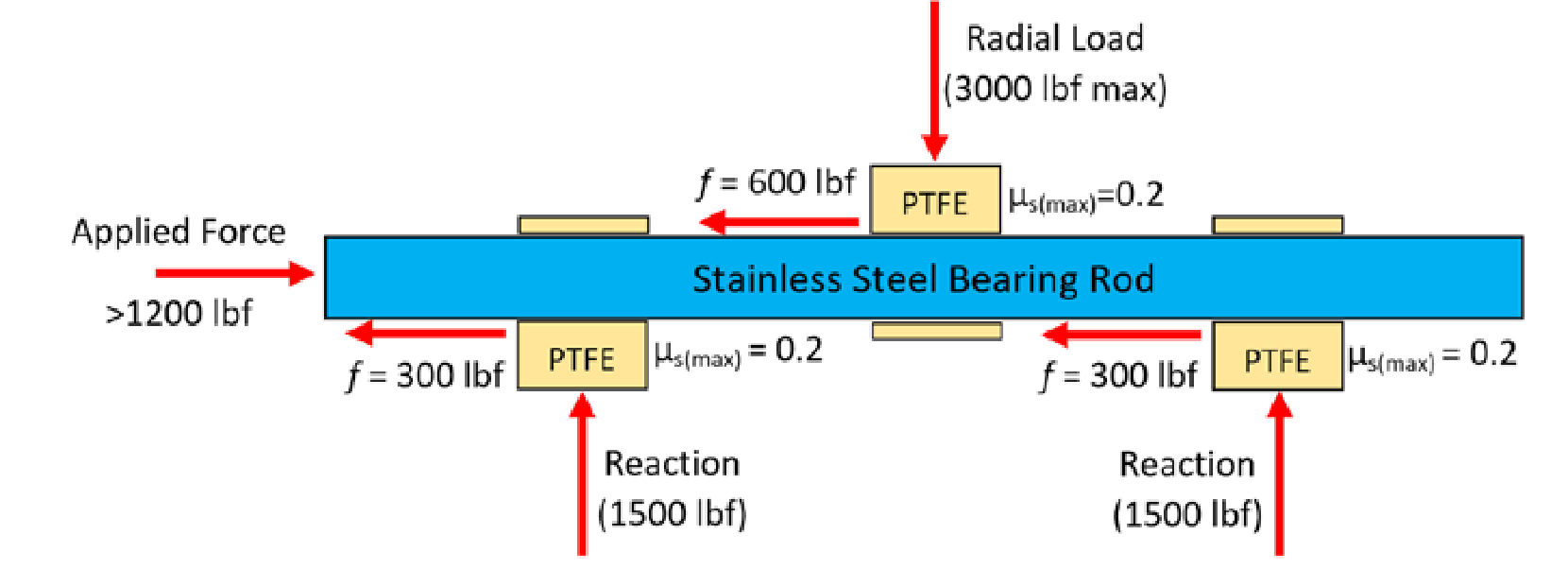
The goal of this project was to design a test bench that simulates the wear of an airplane’s landing gear bearing when it lands. This wear is caused by two main things: During landing, the landing gear compresses and a large rod slides along the bearing. Due to the landing impact, there is also a large radial load applied on the bearing. The combination of the two causes wear and the bearing has to be switched out after a certain amount of cycles. However, the number of cycles is hard to estimate by theoretical analysis, which explains the need for this test bench.
The system consists of two major mechanisms. The sliding of the rod is caused by a slider-crank mechanism, which is driven by a strong motor. The rod is guided by the test bearing as well two additional bearings on both sides of the test bearing. There is also the need to apply a force of up to 3000 lbs on the test bearing to simulate the radial load during landing. This was achieved by two double-acting pneumatic cylinder stacked on top of each other to reduce the footprint. It was controlled by an electric solenoid valve via LABVIEV.